
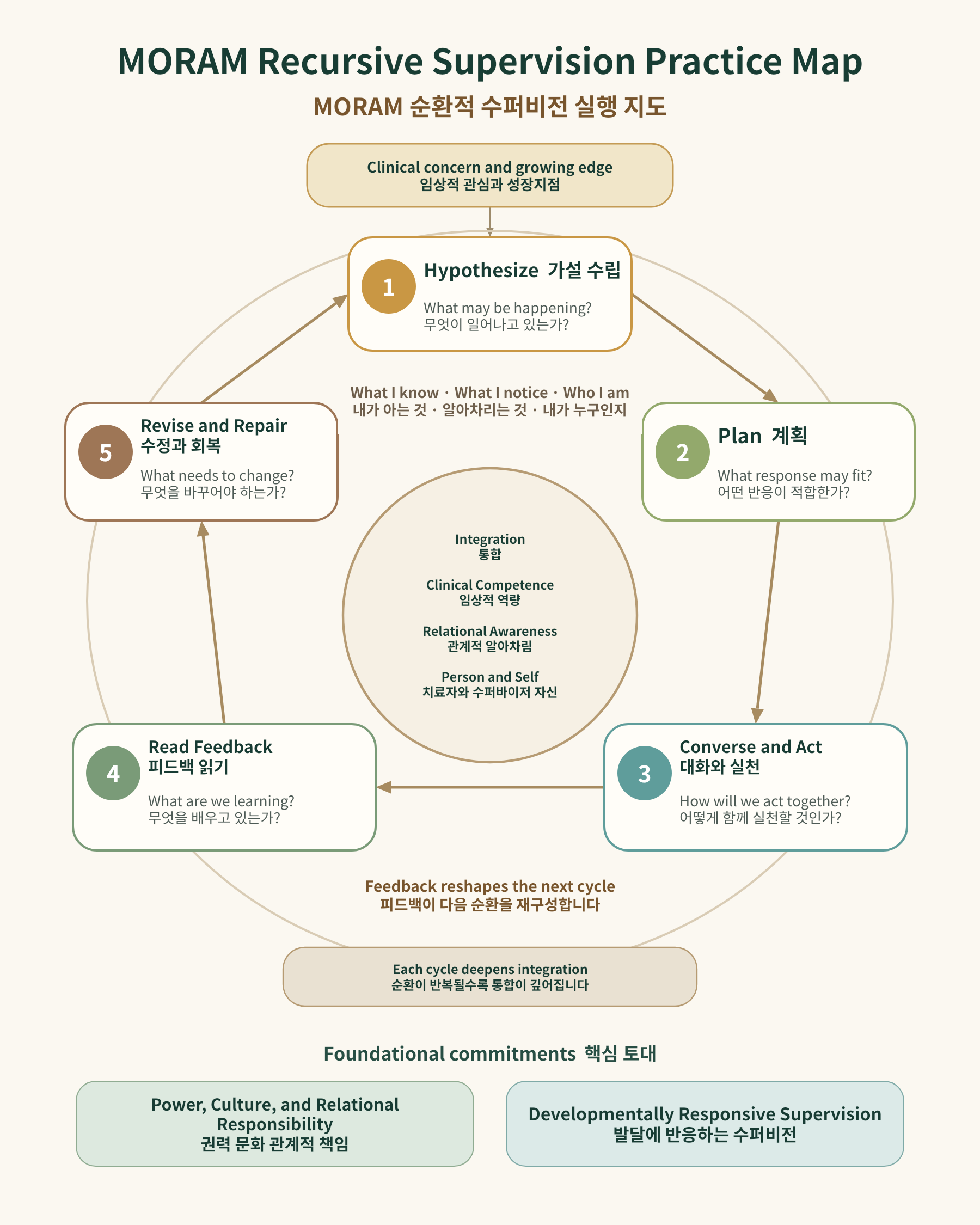
A Recursive Supervision Process
MORAM supervision begins with a clinical concern or developmental growing edge and moves recursively through five interconnected phases:
Hypothesize — Develop a systemic and relational understanding of what may be happening.
Plan — Collaboratively select responses that fit the clinical goals and the supervisee’s developmental needs.
Converse and Act — Put the plan into practice through collaborative therapeutic and supervisory dialogue.
Read Feedback — Attend to verbal and nonverbal responses, relational processes, and changes in clinical outcomes.
Revise and Repair — Use new information to modify hypotheses and plans and address relational tension or disconnection when needed.
These phases do not form a linear sequence with a fixed ending. Feedback reshapes earlier understandings and becomes the starting point for the next cycle. With each cycle, clinical competence, relational awareness, and the therapist’s understanding of self become more deeply integrated.
Developmentally Responsive Supervision
The same form of supervision is not appropriate for every therapist. MORAM adjusts the supervisor’s role and level of structure according to the supervisee’s experience, confidence, clinical competence, learning needs, and stage of professional development.
At times, a therapist may need clear structure, modeling, or direct guidance. At other times, greater autonomy, collaborative reflection, and exploration of professional identity may be more helpful. The goal is not for supervisees to reproduce the supervisor’s way of practicing, but to develop their own sound clinical judgment, relational wisdom, and professional voice.
Power, Culture, and Relational Responsibility
MORAM understands power, culture, identity, and social location as foundational to every aspect of supervision—not as additional topics to be considered only when a particular concern arises.
Supervisor and supervisee explore how race, ethnicity, gender, sexual orientation, socioeconomic position, immigration experience, language, religion, disability, and professional status may shape therapeutic meaning and relational possibilities. Cultural humility, ethical responsibility, client welfare, and relational safety remain central throughout the supervision process.
The Growth MORAM Supervision Supports
MORAM supervision supports therapists in becoming practitioners who can:
Understand complex cases through systemic and relational perspectives
Notice subtle processes unfolding within therapeutic relationships
Use personal strengths and vulnerabilities responsibly
Practice ethically while attending to culture, power, and social context
Revise clinical understanding and intervention in response to feedback
Develop a coherent clinical voice and an evolving professional identity
MORAM supervision is not about becoming a finished therapist. It is about becoming a therapist who can continue learning from self, relationship, and clinical experience.
Whole in Ourselves, Connected with One Another.
Growing as a Whole Therapist, In and Through Relationship.